Pectin Methylesterase In Orange Juice: Supplier Guide for Juice Processing
Buyer guide to PME enzyme selection, dosage, validation, QC, and supplier qualification for orange juice processing lines.
A practical B2B guide for selecting, validating, and purchasing PME enzyme for controlled pectin modification in orange juice and related fruit processing.
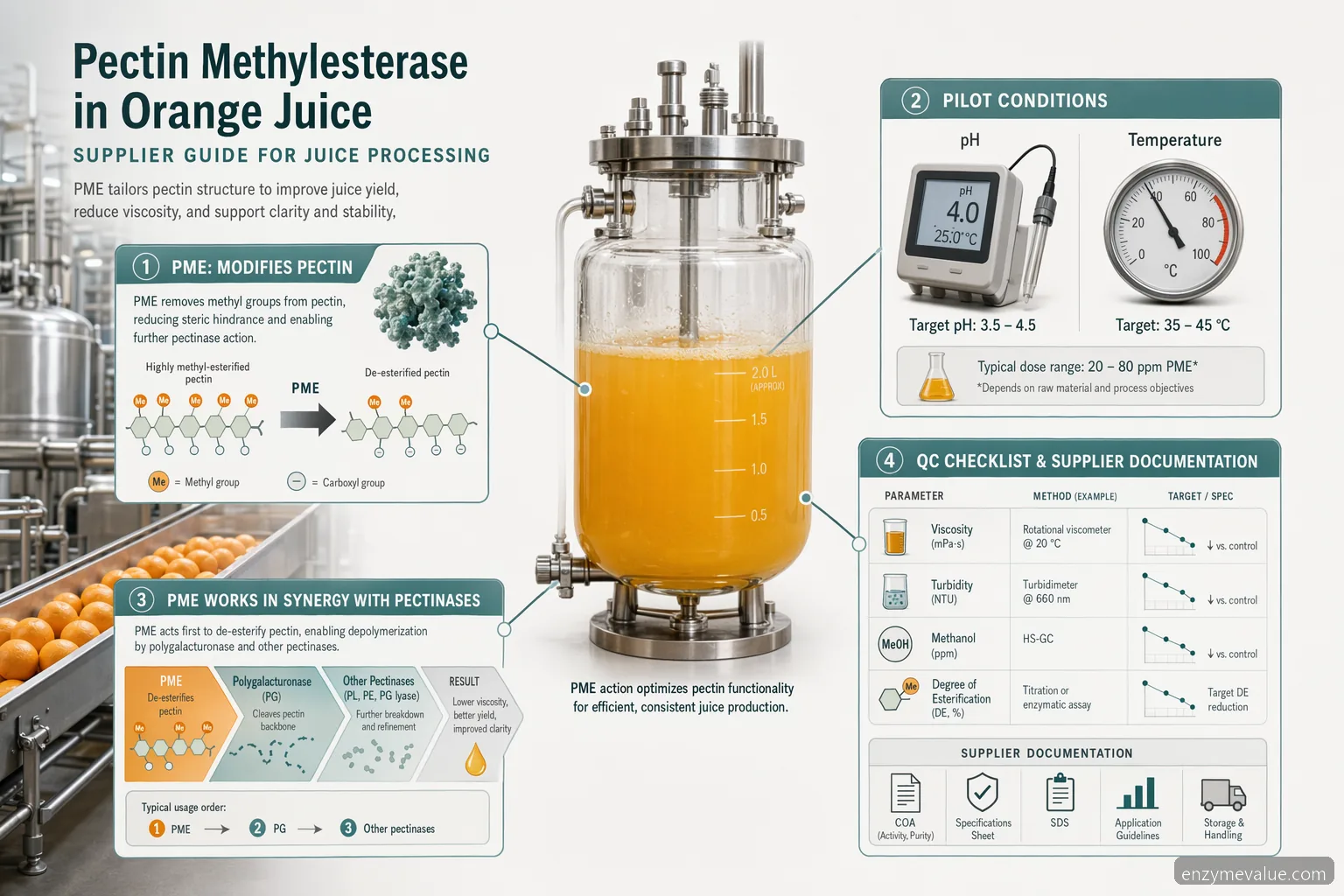
What Pectin Methylesterase Does in Orange Juice
Pectin methylesterase in orange juice acts on methyl-esterified pectin, releasing methanol groups and creating free carboxyl sites on the pectin chain. This changes how pectin interacts with calcium, other pectic enzymes, pulp particles, and process heat. For buyers, the key point is that PME enzyme is not a generic clarification aid; it is a process tool that must be matched to the desired juice profile. In some orange juice operations, endogenous pectin methylesterase orange juice activity is a risk because it can promote pectin-calcium gel networks and cloud loss. In other operations, controlled PME treatment helps prepare pectin for downstream hydrolysis or extraction steps. The purchasing decision should therefore start with the product goal: cloud-stable NFC juice, clarified juice, pulp-modified juice, concentrate, or citrus peel valorization.
Main function: pectin de-esterification • Primary risk: uncontrolled cloud destabilization • Primary opportunity: controlled pectin modification • Best fit: validated process-specific applications
When to Use PME—and When to Control It
In orange juice, PME may be desirable or undesirable depending on whether the process requires cloud retention or pectin breakdown. For premium cloudy juice, the processor often focuses on limiting native PME activity through time-temperature control, pasteurization design, and rapid handling. For clarification, extraction, pulp viscosity reduction, or citrus peel processing, an industrial pectin methylesterase juice processing program may intentionally add PME under controlled conditions. A pectin methylesterase inhibitor can be relevant in research or formulation screening, but most industrial buyers manage PME through validated heat treatment, enzyme selection, pH control, and residence time. The correct approach is not simply to add more enzyme; it is to define the pectin state required at the next process step. This is why a pectin methylesterase supplier for juice processing should review raw material, line layout, heating limits, and target specifications before recommending a grade.
Cloudy juice: prioritize PME control or inactivation • Clarified juice: evaluate PME with other pectinases • Peel processing: test PME for pectin restructuring • Buyer focus: match enzyme use to product specification
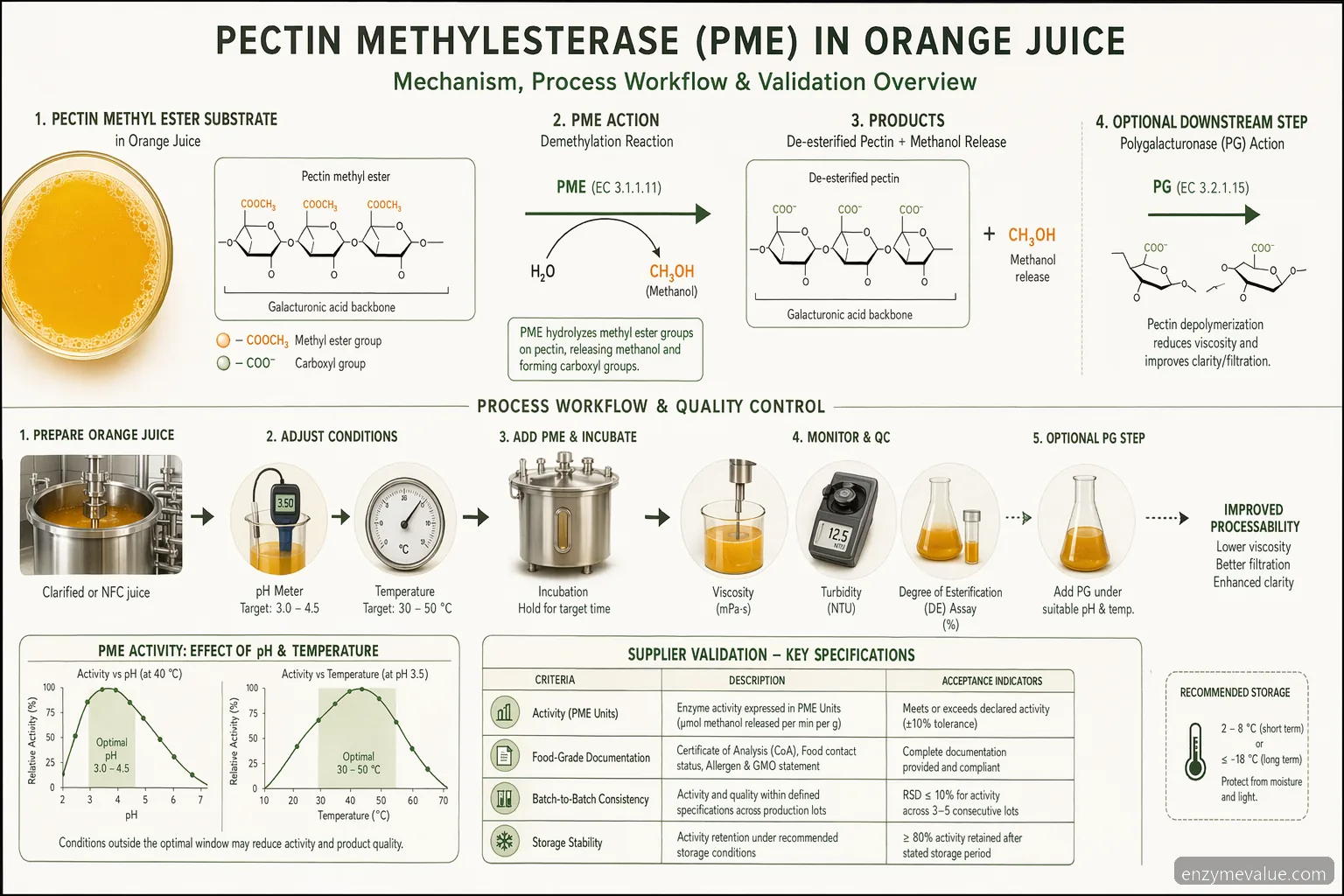
Practical Process Conditions for Pilot Trials
Safe starting conditions for pectin methylesterase for juice processing depend on enzyme source, formulation, activity definition, and fruit matrix. Orange juice typically runs near pH 3.2–4.2, while many PME preparations show useful activity across acidic to mildly neutral ranges, often around pH 4.0–7.5 depending on grade. Pilot trials commonly screen 30–55°C for enzyme reaction steps, with short contact times from 15 to 90 minutes. Dosage should be based on declared activity units, but an initial industrial screen may compare low, medium, and high addition levels such as 20–150 g per metric ton of mash or juice, adjusted only after analytical results. Heat inactivation requirements must be validated because orange PME can be relatively heat resistant. Some processors also examine the combined effect of ultrasound and heat on orange pectin methylesterase to reduce thermal load, but plant fit and product quality must be proven.
Typical orange juice pH screen: 3.2–4.2 • Common enzyme reaction screen: 30–55°C • Pilot contact time: 15–90 minutes • Initial dosage screen: activity-based, matrix-specific • Validate heat inactivation on the actual line
Using PME with Polygalacturonase and Other Pectinases
PME is frequently evaluated as part of a pectinase system rather than as a stand-alone solution. By de-esterifying pectin, PME can make the polymer more accessible to polygalacturonase, which hydrolyzes the galacturonic acid backbone. This is why processors may study pectin methylesterase and polygalacturonase pear juice trials, then adapt the same logic to orange, apple, or blended juice systems with different pH and pulp loads. Pectin methylesterase in tomato juice is also relevant for viscosity and texture management, although tomato matrices have different solids, calcium, and heat histories. For orange processing, blends may include polygalacturonase, pectin lyase, cellulase, or hemicellulase depending on whether the target is yield, clarification, filtration rate, or peel extraction. Buyers should request separate activity declarations for each enzyme class when purchasing blends, because a generic pectinase label does not reveal the functional balance.
PME prepares pectin for further modification • Polygalacturonase supports backbone hydrolysis • Pectin lyase may assist clarification at suitable pH • Blend composition should be disclosed in functional terms
QC Checks Before Scaling PME in Juice Processing
A well-run PME validation plan connects enzyme addition to measurable juice outcomes. Quality control should include incoming fruit pH, °Brix, pulp level, calcium, viscosity, turbidity or NTU, cloud stability, serum separation, and filtration behavior. For enzyme performance, ask the supplier to explain the activity assay used for the PME enzyme, including substrate, pH, temperature, and unit definition. In the plant trial, compare untreated control, heat-only control, PME dose levels, and PME plus companion pectinase where applicable. Analytical indicators may include change in degree of esterification, titratable acid shift during reaction, methanol release within regulatory and product safety expectations, and pectin molecular weight distribution if available. For finished juice, confirm sensory impact, color, pulp mouthfeel, microbial stability, and shelf-life behavior. The objective is to prove reproducible cost-in-use, not merely to observe a faster lab reaction.
Track pH, °Brix, pulp, calcium, viscosity, and NTU • Use untreated and heat-only controls • Confirm activity assay conditions • Check cloud stability and serum separation • Document finished-product sensory impact
Supplier Qualification and Purchasing Criteria
For B2B procurement, a qualified pectin methylesterase supplier should provide a current Certificate of Analysis, Technical Data Sheet, and Safety Data Sheet before samples enter a pilot plant. The COA should identify batch number, activity, appearance, microbiological limits where applicable, and expiration or retest date. The TDS should state recommended pH, temperature range, dosage guidance, storage conditions, carrier or diluent type, and compatibility with other enzymes. The SDS should support safe industrial handling, spill response, and PPE decisions. Buyers should also request allergen information, production organism disclosure where available, GMO status statement if required by the market, and country-of-origin documentation. Commercial comparison should be based on cost-in-use: enzyme price, dosage, yield gain, reduced filtration time, energy change, product loss, and operational risk. The strongest supplier is the one that supports pilot validation and transparent technical documentation.
Request COA, TDS, and SDS before trials • Compare enzyme grades by cost-in-use • Confirm storage and shelf-life requirements • Qualify technical support and batch consistency • Avoid relying on unverified marketing claims
Technical Buying Checklist
Buyer Questions
No. Pectin methylesterase in orange juice can either help or harm the process. If the goal is a stable cloudy juice, uncontrolled native PME may contribute to cloud loss and serum separation. If the goal is controlled pectin modification, clarification, or peel processing, added PME can be useful. The decision should be based on product specification, raw material behavior, and pilot data.
Dosage should be based on the supplier’s declared activity units and the process objective. As a practical first screen, processors may compare low, medium, and high treatments, such as 20–150 g per metric ton of mash or juice, when appropriate for the formulation. Final dosage should only be set after measuring viscosity, turbidity, cloud stability, yield, filtration rate, and sensory impact.
A qualified supplier should provide a COA, TDS, and SDS for the exact batch or commercial grade. Buyers should review activity, assay method, batch number, appearance, microbial specifications where applicable, storage conditions, shelf-life, recommended pH and temperature, and handling guidance. For market access, also request allergen information, production organism disclosure where available, GMO status statement if needed, and country-of-origin documentation.
Heat treatment is commonly used to reduce endogenous PME activity, but orange juice PME can be relatively heat resistant, so plant validation is essential. Some studies evaluate the combined effect of ultrasound and heat on orange pectin methylesterase to reduce thermal intensity. Industrial adoption should confirm enzyme reduction, microbial safety, sensory quality, pulp behavior, equipment fit, and throughput before changing a pasteurization program.
Often, yes, but only when the target requires deeper pectin breakdown. PME de-esterifies pectin, while polygalacturonase can hydrolyze the pectin backbone more effectively after de-esterification. This combination is relevant in clarification, viscosity reduction, and some pear, apple, tomato, or citrus systems. For cloudy orange juice, however, the same activity may be undesirable unless tightly controlled and validated.
Related Search Themes
pectin methylesterase orange juice, pectin methylesterase supplier for juice processing, pectin methylesterase in tomato juice, pectin methylesterase for juice processing, pectin methylesterase and polygalacturonase pear juice, industrial pectin methylesterase juice processing
Pectin Methylesterase (PME) for Research & Industry
Need Pectin Methylesterase (PME) for your lab or production process?
ISO 9001 certified · Food-grade & research-grade · Ships to 80+ countries
Frequently Asked Questions
Is pectin methylesterase in orange juice always beneficial?
No. Pectin methylesterase in orange juice can either help or harm the process. If the goal is a stable cloudy juice, uncontrolled native PME may contribute to cloud loss and serum separation. If the goal is controlled pectin modification, clarification, or peel processing, added PME can be useful. The decision should be based on product specification, raw material behavior, and pilot data.
What dosage of PME enzyme should a juice processor test first?
Dosage should be based on the supplier’s declared activity units and the process objective. As a practical first screen, processors may compare low, medium, and high treatments, such as 20–150 g per metric ton of mash or juice, when appropriate for the formulation. Final dosage should only be set after measuring viscosity, turbidity, cloud stability, yield, filtration rate, and sensory impact.
What documents should a pectin methylesterase supplier provide?
A qualified supplier should provide a COA, TDS, and SDS for the exact batch or commercial grade. Buyers should review activity, assay method, batch number, appearance, microbial specifications where applicable, storage conditions, shelf-life, recommended pH and temperature, and handling guidance. For market access, also request allergen information, production organism disclosure where available, GMO status statement if needed, and country-of-origin documentation.
Can heat or ultrasound control orange pectin methylesterase?
Heat treatment is commonly used to reduce endogenous PME activity, but orange juice PME can be relatively heat resistant, so plant validation is essential. Some studies evaluate the combined effect of ultrasound and heat on orange pectin methylesterase to reduce thermal intensity. Industrial adoption should confirm enzyme reduction, microbial safety, sensory quality, pulp behavior, equipment fit, and throughput before changing a pasteurization program.
Should PME be used with polygalacturonase in juice processing?
Often, yes, but only when the target requires deeper pectin breakdown. PME de-esterifies pectin, while polygalacturonase can hydrolyze the pectin backbone more effectively after de-esterification. This combination is relevant in clarification, viscosity reduction, and some pear, apple, tomato, or citrus systems. For cloudy orange juice, however, the same activity may be undesirable unless tightly controlled and validated.
Related: Pectin Methylesterase for Better Texture Control
Turn This Guide Into a Supplier Brief Request a PME enzyme sample, COA, TDS, SDS, and pilot-trial support for your juice processing line. See our application page for Pectin Methylesterase for Better Texture Control at /applications/pectin-methylesterase-optimum/ for specs, MOQ, and a free 50 g sample.
Contact Us to Contribute