Pectin Lyase and Pectin Methylesterase Production by Penicillium citrinum: Dosage, pH, and Temperature
Troubleshoot PME enzyme production from Penicillium citrinum with dosage, pH, temperature, assay, QC, and supplier qualification guidance.
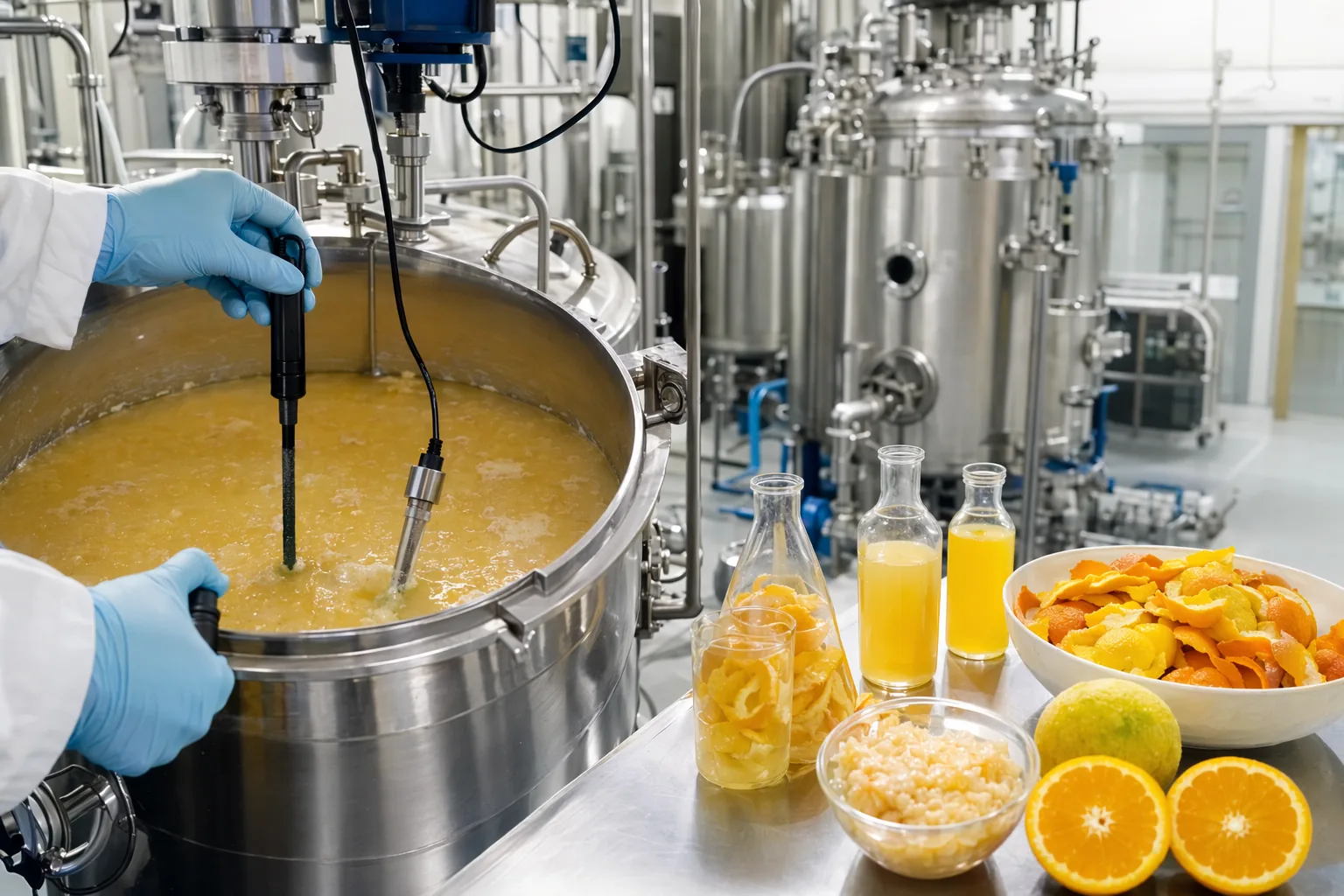
A practical B2B guide for food and ingredient processors evaluating PME enzyme performance in juice processing, jam systems, and citrus peel valorization.
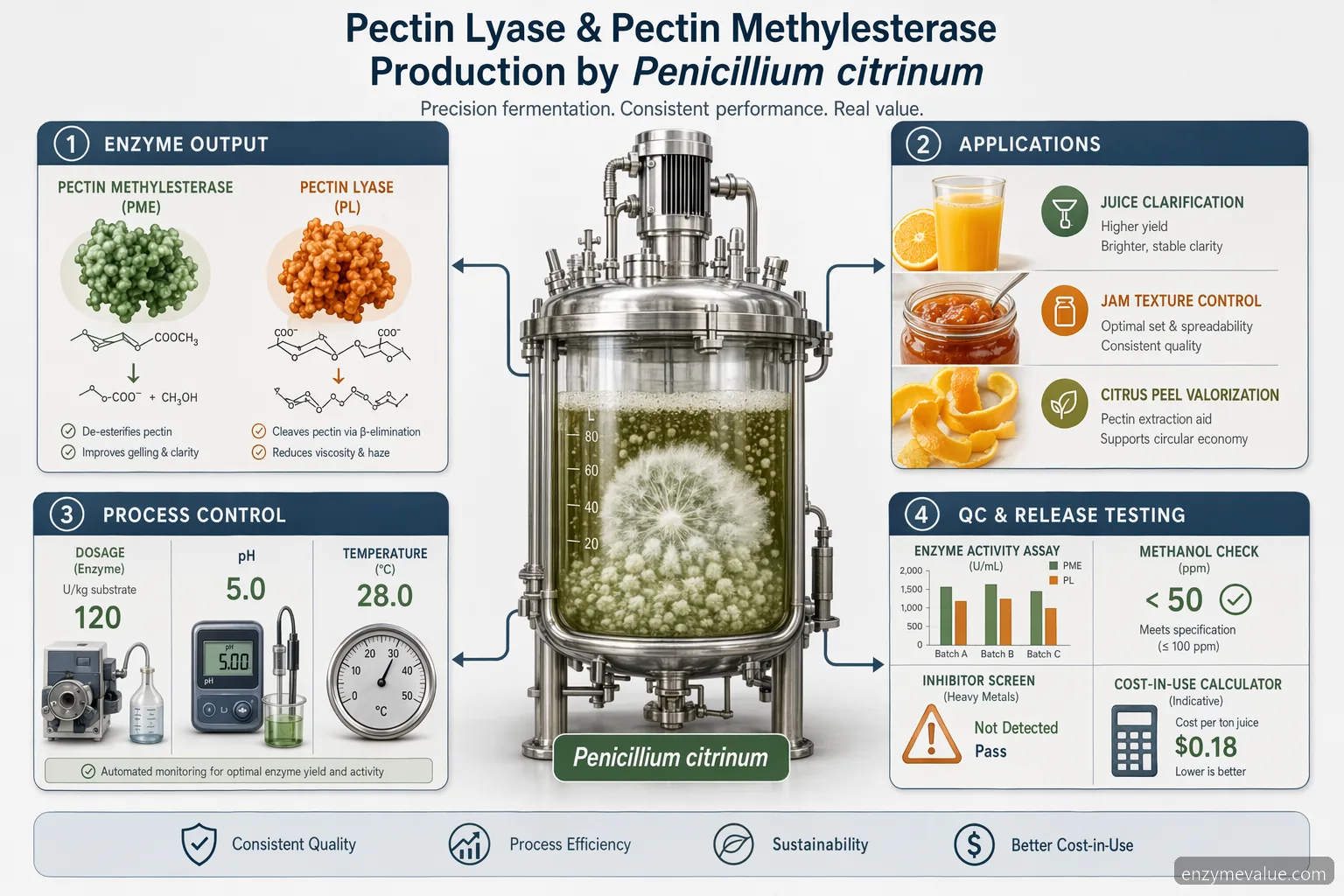
How Penicillium citrinum Fits in Industrial PME Supply
Pectin lyase and pectin methylesterase production by Penicillium citrinum is relevant when a processor needs a fungal pectinolytic system for fruit, vegetable, or citrus by-product streams. Pectin methylesterase, also called PME enzyme or pectin esterase, removes methyl ester groups from pectin. Pectin lyase cleaves highly esterified pectin chains, while PME shifts pectin toward lower esterification and can improve or destabilize texture depending on calcium and process design. In B2B procurement, the key question is not whether the organism can produce the enzyme, but whether the supplier can deliver consistent activity, low unwanted side activities, and documented suitability for the intended food process. Buyers should request the activity definition, production organism disclosure where available, carrier information, allergen statement if applicable, and intended-use guidance before starting trials.
Primary applications: juice processing, jam texture control, and citrus peel treatment. • Common names: pectin methylesterase, PME enzyme, pectin esterase, de-esterification enzyme. • Performance depends on substrate pectin type and degree of esterification. • Procure against activity, quality documents, and pilot results, not headline enzyme name alone.
Troubleshooting Fermentation Yield and Enzyme Balance
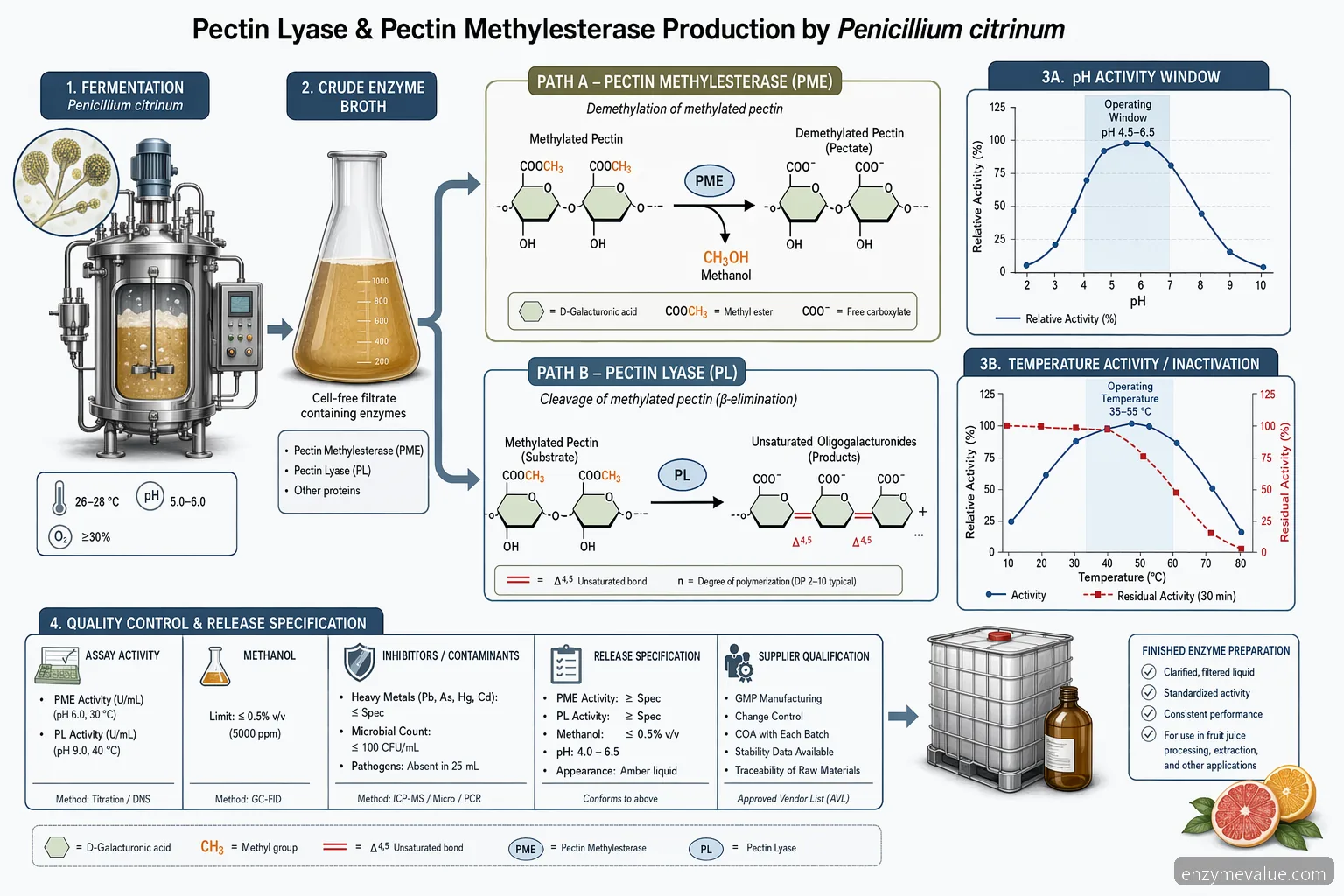
For manufacturers producing pectin lyase and PME in-house or through contract fermentation, yield variability often starts with substrate, pH drift, aeration, and harvest timing. Penicillium citrinum processes may use pectin-rich induction materials such as citrus peel, apple pomace, or purified pectin, but raw materials should be screened for ash, soluble sugars, microbial load, and inhibitor content. A practical submerged fermentation development window is often 25–32°C with an initial acidic pH, commonly around pH 4.0–6.0, then adjusted based on strain performance and the desired pectin lyase-to-PME ratio. Solid-state systems can increase induction on peel-based substrates, but they require tighter moisture and heat control. If PME activity rises while pectin lyase is low, review nitrogen source, induction strength, harvest time, and oxygen transfer. If both activities are low, confirm inoculum vitality, contamination status, and assay calibration.
Track both PME and pectin lyase activity during the run, not only total pectinase. • Compare harvest points because activity ratios may shift over time. • Validate substrate lots before scale-up to avoid peel-to-peel variability. • Use a retained reference sample to separate fermentation failure from assay error.
PME Dosage Strategy for Production Trials
Industrial dosage should begin with a small matrix trial because pectin content, soluble solids, calcium, particle size, and residence time strongly affect results. For juice and fruit preparations, a cautious screening band is often 5–100 PME activity units per kg or L of substrate, adjusted to the supplier’s unit definition and target endpoint. When only mass-based dosing is provided, processors may start with a narrow product range such as 10–200 ppm, but this must be converted to activity using the COA. For jam or calcium-assisted gel systems, too little PME may give weak structure, while too much can cause over-de-esterification, syneresis, or processing viscosity changes. For citrus peel, dosage should be tied to peel hydration, particle size, and extraction goals. Always test with real plant water, process pH, and heating profile.
Dose by activity units wherever possible. • Run control, low, medium, and high enzyme levels in the same raw material lot. • Measure endpoint viscosity, yield, turbidity, texture, or de-esterification level. • Confirm whether side activities such as polygalacturonase are desirable or unwanted.
pH, Temperature, and Inactivation Windows
Pectin methylesterase in food usually performs in mildly acidic to near-neutral conditions, but the exact optimum depends on enzyme source and formulation. Many fungal PME preparations are evaluated around pH 3.5–5.5 for fruit processing, with temperature screening commonly performed from 30–55°C. Higher temperature can accelerate reaction rate, but it can also shorten active life and change pectin behavior. In orange juice, PME control is especially important because residual activity can contribute to cloud loss by de-esterifying pectin and promoting calcium-mediated clarification. If the process requires enzyme activity only during a defined hold step, validate thermal inactivation in the real matrix. Typical plant trials assess whether heating in the 80–95°C range for an appropriate residence time stops activity, but heat stability varies. Confirm residual PME after pasteurization rather than assuming full inactivation.
Screen pH at the actual soluble-solids level and acid system. • Run temperature trials at expected plant residence times. • Check residual activity after heating when cloud stability matters. • Document the selected window in the process specification.
QC Checks: Assay, Methanol, Inhibitors, and Release Testing
A pectin methylesterase assay should be selected before supplier comparison, because titrimetric, pH-stat, colorimetric, and methanol-based methods may report different activity units. Ask suppliers to provide the activity method on the COA and repeat the same method internally or through a qualified laboratory. Pectin methylesterase methanol production is an important QC topic because each de-esterification reaction can release methanol. For many applications the risk is manageable, but processors should measure methanol when using high PME dose, long contact time, high-pectin substrates, or concentrated citrus streams. Also consider pectin methylesterase inhibitor effects: plant-derived inhibitors, heat-damaged raw materials, or certain fruit fractions may reduce apparent PME activity. Batch release should include activity, microbial limits appropriate to the intended use, moisture or carrier data where relevant, and absence of abnormal odor, discoloration, or caking.
Align supplier COA activity with the plant acceptance assay. • Monitor methanol when regulatory, sensory, or concentration factors make it critical. • Use blank substrate controls to identify natural PME or inhibitors. • Retain samples from each production lot for deviation investigation.
Supplier Qualification and Cost-in-Use Evaluation
For industrial purchasing, the lowest price per kg is rarely the best measure. Compare cost-in-use based on activity delivered to the process, dose required to hit the endpoint, yield improvement, rework reduction, and any extra inactivation or filtration burden. A qualified supplier should provide a technical data sheet, safety data sheet, certificate of analysis, recommended storage conditions, shelf-life basis, lot traceability, and guidance for pilot validation. Review whether the product is a single-enzyme preparation or a pectinolytic blend, because pectin lyase, polygalacturonase, cellulase, or hemicellulase side activities can change texture, juice clarity, and peel extraction behavior. Before approval, run at least one pilot under normal plant variability, then confirm at production scale with QC checkpoints. Lock the specification only after the enzyme consistently meets performance and quality expectations.
Request COA, TDS, SDS, activity definition, and storage guidance. • Evaluate cost per finished ton or batch, not only purchase price. • Confirm side activity profile against the application goal. • Use pilot validation before long-term supply approval.
Technical Buying Checklist
Buyer Questions
Pectin methylesterase is an enzyme that removes methyl ester groups from pectin, producing lower-ester pectin and releasing methanol. In food processing, its effect can be useful or harmful depending on the goal. It may support calcium-related texture development in some systems, but residual activity in orange juice can contribute to cloud instability. Industrial buyers should evaluate it by activity, process conditions, and endpoint performance.
Pectin methylesterase in orange juice is controlled through time, temperature, pH, and sometimes enzyme selection or inactivation design. Because residual PME can de-esterify pectin and promote calcium-mediated cloud loss, processors should measure residual activity after pasteurization or heat treatment. Do not rely on generic heat assumptions; validate the real juice, soluble solids, pulp level, residence time, and target shelf-life.
A plant should use an assay that matches the supplier’s COA or can be correlated to it. Common options include titration, pH-stat, colorimetric, and methanol-release methods. The best choice depends on available equipment, matrix interference, and the production endpoint. For supplier comparison, use the same method, substrate, pH, temperature, and reaction time so dosage decisions are not distorted by different unit definitions.
Yes. A pectin methylesterase inhibitor can reduce apparent enzyme performance, especially in plant-derived materials that naturally contain inhibitory proteins or compounds. Heat treatment, raw material maturity, and fruit fraction can also change inhibitor behavior. If a normal dose suddenly underperforms, run a blank, spike a reference enzyme into the substrate, and compare activity in buffer versus process matrix to separate enzyme failure from substrate inhibition.
Compare suppliers by cost-in-use, not only price per kg. Request COA, TDS, SDS, activity definition, lot traceability, storage conditions, and side activity information. Run the same pilot protocol for each candidate and measure the target endpoint, residual activity, methanol where relevant, and downstream processing impact. Approve the supplier only after consistent performance across representative raw material lots and production conditions.
Pectin Methylesterase (PME) for Research & Industry
Need Pectin Methylesterase (PME) for your lab or production process?
ISO 9001 certified · Food-grade & research-grade · Ships to 80+ countries
Frequently Asked Questions
What is pectin methylesterase in industrial food processing?
Pectin methylesterase is an enzyme that removes methyl ester groups from pectin, producing lower-ester pectin and releasing methanol. In food processing, its effect can be useful or harmful depending on the goal. It may support calcium-related texture development in some systems, but residual activity in orange juice can contribute to cloud instability. Industrial buyers should evaluate it by activity, process conditions, and endpoint performance.
How is pectin methylesterase in orange juice usually controlled?
Pectin methylesterase in orange juice is controlled through time, temperature, pH, and sometimes enzyme selection or inactivation design. Because residual PME can de-esterify pectin and promote calcium-mediated cloud loss, processors should measure residual activity after pasteurization or heat treatment. Do not rely on generic heat assumptions; validate the real juice, soluble solids, pulp level, residence time, and target shelf-life.
What pectin methylesterase assay should a plant use?
A plant should use an assay that matches the supplier’s COA or can be correlated to it. Common options include titration, pH-stat, colorimetric, and methanol-release methods. The best choice depends on available equipment, matrix interference, and the production endpoint. For supplier comparison, use the same method, substrate, pH, temperature, and reaction time so dosage decisions are not distorted by different unit definitions.
Can a pectin methylesterase inhibitor affect production performance?
Yes. A pectin methylesterase inhibitor can reduce apparent enzyme performance, especially in plant-derived materials that naturally contain inhibitory proteins or compounds. Heat treatment, raw material maturity, and fruit fraction can also change inhibitor behavior. If a normal dose suddenly underperforms, run a blank, spike a reference enzyme into the substrate, and compare activity in buffer versus process matrix to separate enzyme failure from substrate inhibition.
How should buyers compare PME enzyme suppliers?
Compare suppliers by cost-in-use, not only price per kg. Request COA, TDS, SDS, activity definition, lot traceability, storage conditions, and side activity information. Run the same pilot protocol for each candidate and measure the target endpoint, residual activity, methanol where relevant, and downstream processing impact. Approve the supplier only after consistent performance across representative raw material lots and production conditions.
Related: Pectin Methylesterase for Better Texture Control
Turn This Guide Into a Supplier Brief Request a PME enzyme evaluation pack with COA, TDS, SDS, dosage guidance, and pilot-trial support for your production line. See our application page for Pectin Methylesterase for Better Texture Control at /applications/pectin-methylesterase-optimum/ for specs, MOQ, and a free 50 g sample.
Contact Us to Contribute